

1.2.6: Using the model#
The final stage of the cycle returns to where it started: the real world. The cycle began because a question about a real system needed answering, and Nikolic, van Dam and Lukszo describe this stage as the point at which the simulation results are brought back to the problem that motivated the work [1]. The modeller uses the analysed output to predict, to analyse, or to understand the system, and communicates what the model has shown to whoever needs the answer. This section asks what it means to do that stage well, and then shows it at work on the traffic model.
1.2.6.1: What it means to use a model well#
Using a model well means going beyond describing what the graphs show, to explaining why the patterns appear and relating that explanation back to the research question [1]. A convincing conclusion follows a traceable chain: the experimental conditions produced a result, the model’s rules and interactions explain that result, and the assumptions define how far the explanation can travel beyond the model. It also considers plausible alternative explanations and reports uncertainty across runs instead of presenting one convenient outcome as decisive.
That involves three things:
Tracing an observed system-level pattern back to the entities’ behaviours and interactions, and identifying the feedback loops and causal chains that produce it [1].
Connecting the results into a clear story, so a finding becomes an answer to the question rather than a loose collection of graphs [1].
Saying plainly the conditions under which the result holds and the assumptions it rests on, so others know how far to trust it [1].
Of these three, mechanism reasoning is the one this section develops in depth, and the traffic example below traces it step by step; the coherent narrative and the stated limitations are the frame in which that mechanism is reported.
1.2.6.2: Mechanistic understanding, not point predictions#
Because the value of these models lies in mechanism, the output is a particular kind of answer. A point Nikolic and colleagues make explicitly is that these models generate understanding of mechanisms rather than precise predictions of specific outcomes. The value is usually in showing how individual behaviours combine into system-level patterns, and what changes when those behaviours change [1]. That kind of mechanistic understanding is often what policy decisions, scientific arguments, and design choices need.
The distinction is easy to state and easy to blur, so the activity below asks you to judge a series of claims: is each a legitimate mechanistic insight, or a point prediction the model cannot support?
Keeping that line clear is what stops a mechanistic result from being oversold as a precise forecast it was never meant to deliver.
1.2.6.3: Why the cycle iterates#
The cycle is iterative for a reason that becomes clearest here. Using the model often raises new questions: a result may suggest a refinement to the conceptual model, an extra parameter worth sweeping, or a validation check that was not done earlier. Each sends the modeller back through the cycle with the model improved by what the last run taught [1]. The loop at the centre of the cycle diagram is not decorative.
With that general account in place, the traffic model shows what using a model well looks like in practice.
1.2.6.4: The traffic example#
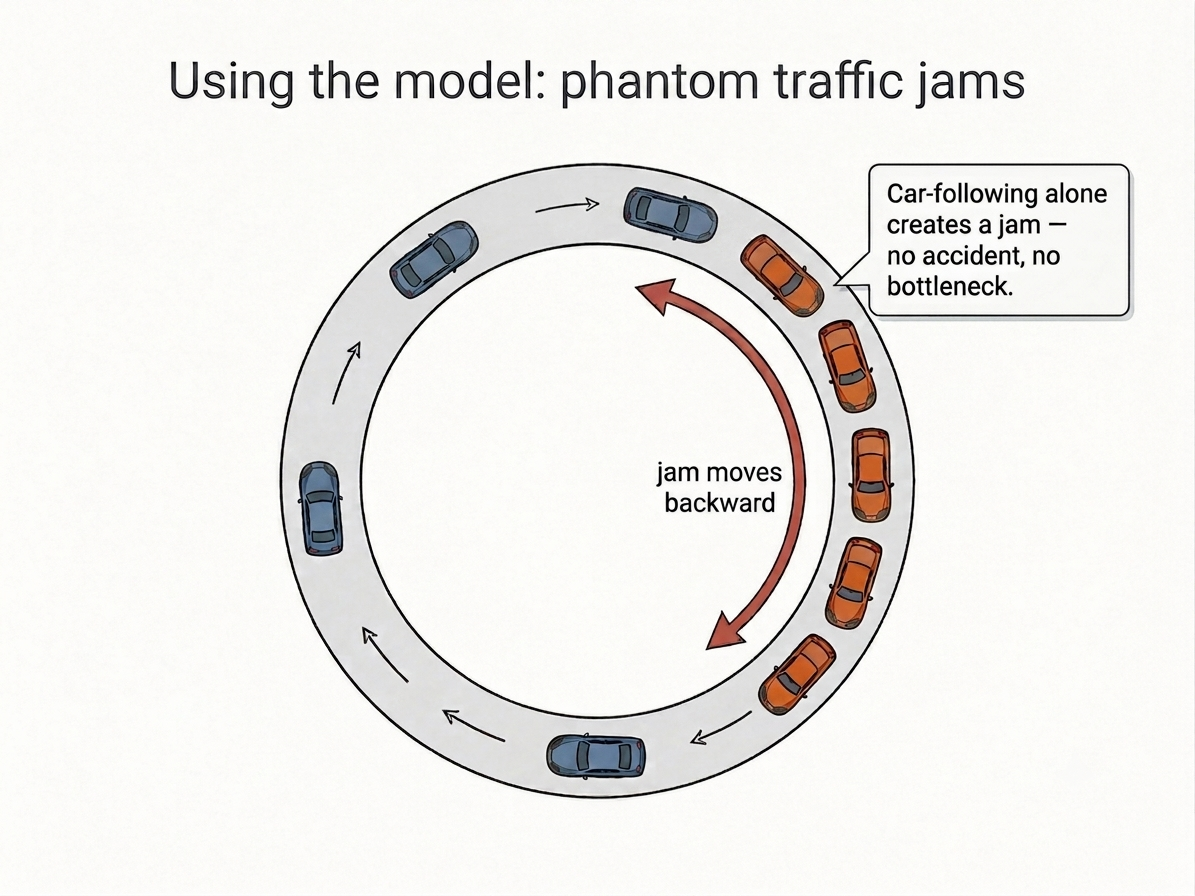
Fig. 10 Figure 1.10 The conclusion carried back to the real world: car-following behaviour alone is enough to produce a “phantom jam”, a cluster of slowed vehicles that forms and persists with no accident, bottleneck, or external cause.#
For the traffic model, the question was whether the interactions between individual vehicles can, on their own, produce the spontaneous jams that real roads show. Once the experiments have been run and analysed, the modeller can answer with evidence: at what densities jams appear, how sensitive their formation is to driver behaviour, and how the model compares with what the empirical literature reports [2]. The mechanism is then stated in terms of the vehicles themselves: a small slow-down by one vehicle forces the one behind to brake a little harder, which forces the next to brake harder still, and this amplification travelling back along the line is what appears, at the level of the whole road, as a backward-moving congestion wave.
The result is not a precise prediction about any specific road on any specific day. It is a mechanistic understanding: the simple act of adjusting speed to the vehicle ahead is enough, on its own, to produce the kind of congestion that appears on real roads without any external cause [2]. If a more specific question arises later, perhaps about a particular road or about variable speed limits, the modeller can return to the cycle with this model as a starting point and refine it [1].
1.2.6.5: Trace the mechanism#
This kind of mechanism reasoning is the goal of the whole cycle, because it turns a set of results into an account of how the system works, which is what a scientific argument or a design decision needs. In the activity below, reconstruct that chain for the phantom jam, from one driver’s small slow-down to the jam seen across the whole road. No single step is the cause; the pattern lives in the whole sequence.
The jam had no single cause; it emerged from the whole chain of reactions running back along the line. Being able to state a mechanism in that way, from individual behaviour up to the system-level pattern, is what it means to use a model rather than merely run one.
With all seven stages now covered, the next section (1.2.7) walks a single applied example through the whole cycle from start to finish.
Key takeaways#
Key takeaways
The last stage carries the analysed results back to the real-world question, explaining why the patterns appear, not just describing them.
These models mostly deliver mechanistic understanding (how individual behaviour produces system-level patterns) rather than precise point predictions.
Using a model usually raises new questions, sending the modeller back around the cycle with an improved model.